Tips On Caring for Your Child’s Teeth

Tips On Caring for Your Child’s Teeth

As a parent I know how difficult it can be to get your child to start brushing their teeth on a regular basis and making sure they eat healthy foods that will aid their dental needs. Trust me, you’re not alone! Truth is the health of your child’s teeth actually begin before birth. That’s why it is important to eat a healthy, well balanced and nutritious diet while pregnant and get all the vitamins and minerals you need. As a parent it is important that you start your child’s dental care when their first set of teeth appear. This is important because it will help you and your child’s dentist see how healthy your child’s teeth are and predict the likelihood of your child having potential dental problems. The best way to avoid future potential dental problems is to start your child’s dental care as soon as possible. This can be done in a variety of different ways.
  • Avoid sharing utensils with younger children. Although this sounds like an innocent act, you’re not only sharing utensils but bacteria as well.
  • Avoid kissing babies in the mouth. Kissing also is a way to transfer bacteria.
  • Don’t put small children to bed with a bottle. In doing so your encouraging sugar and acids in the liquid substance to sit on teeth which can lead to tooth decay.
  • Feed your child healthy, nutritious foods that help the gums remain healthy and develop strong teeth.
  • Keep younger children away from smoking. If your child is presented with any type of cigarette smoke it can cause tooth decay, gum disease or other dental issues.
  • Don’t let your child suck their thumb. Thumb sucking can lead to teeth becoming misaligned or pushed outward.

Always remember, the prettiest thing your child can wear is a smile!

Recent Comments

    Archives

    Office Hours

    Monday 10:00 to 6:00
    Tuesday 10:00 to 6:00
    Wednesday 11:00 to 8:00
    Thursday 10:00 to 6:00
    Friday 10:00 to 6:00
    Saturday 8:00 to 3:00
    Sunday Appointment only

    How to Identify Periodontal Disease

    How to Identify Periodontal Disease

    Most people may be totally unaware of having periodontal disease. Before major periodontal disease symptoms and pain occurs, this oral health issue may have already set in. Those who do not get regular dental check-ups could be well on their way to losing their teeth simply because they neglect to go to the dentist and have their teeth checked. Before simple gum problems become severe, it is important that regular dental check-ups with a dentist are made to identify periodontal disease.

    Signs that you have periodontal disease:

    1. Bad breath that won’t go away. This is the first clue to periodontal disease – bad breath that is constant and just simply won’t go away. Some factors that contribute to bad breath may have nothing to do with periodontal disease such as your diet – if you are fond of coffee, sugar, spicy foods – and medication for colds and high blood pressure to name a few.  However, since about 80% of the population has periodontal disease, it is most likely that bad breath is caused by this disease in the mouth.
    2. Red or swollen gums. Those plump red gums that may look healthy to the uneducated eye are really symptoms of periodontal disease. Pay particular attention to the areas around the tooth. Red or purple coloring around the tooth indicate the disease. Healthy gums are pink and not smooth and puffy like a water balloon.
    3. Tender or bleeding gums. Gums that are tender to the touch and that bleed with the slightest aggravation are sure signs of periodontal disease. Your gums should not bleed when brushing or flossing. Bleeding gums are an indication that the tissue is dying and infection is setting in.
    4. Painful chewing. If you have sharp pain located in just one tooth, it could be tooth decay, a cracked tooth, one in need of a root canal or a new filling that is too high. Some who have TMJ (Temporomandibular joint dysfunction) experience jaw pain, which is different than teeth hurting from chewing. Overall pain experienced while chewing is often the result of periodontal disease.
    5. Loose teeth. Periodontal disease causes your teeth to be somewhat loose due to plaque deposits along and under the gum line of your tooth. The tooth loses its support into the jaw and pockets form around the tooth further collecting bacteria, worsening the problem.
    6. Sensitive teeth. Sensitivity to hot, cold, sweet, sour and cold air is a symptom of periodontal disease. Gums that are receding due to the disease expose the root surfaces that lead to the nerves in the tooth. When the external stimulus (hot, cold, etc.) is introduced to the exposed portion of the tooth, pain is felt in the nerves.
    Although late stages of periodontal disease show obvious signs, early stages do not. Visit your dentist before these periodontal disease symptoms appear.

    Recent Comments

      Archives

      Office Hours

      Monday 10:00 to 6:00
      Tuesday 10:00 to 6:00
      Wednesday 11:00 to 8:00
      Thursday 10:00 to 6:00
      Friday 10:00 to 6:00
      Saturday 8:00 to 3:00
      Sunday Appointment only

      How to Manage Dry Mouth

      How to Manage Dry Mouth

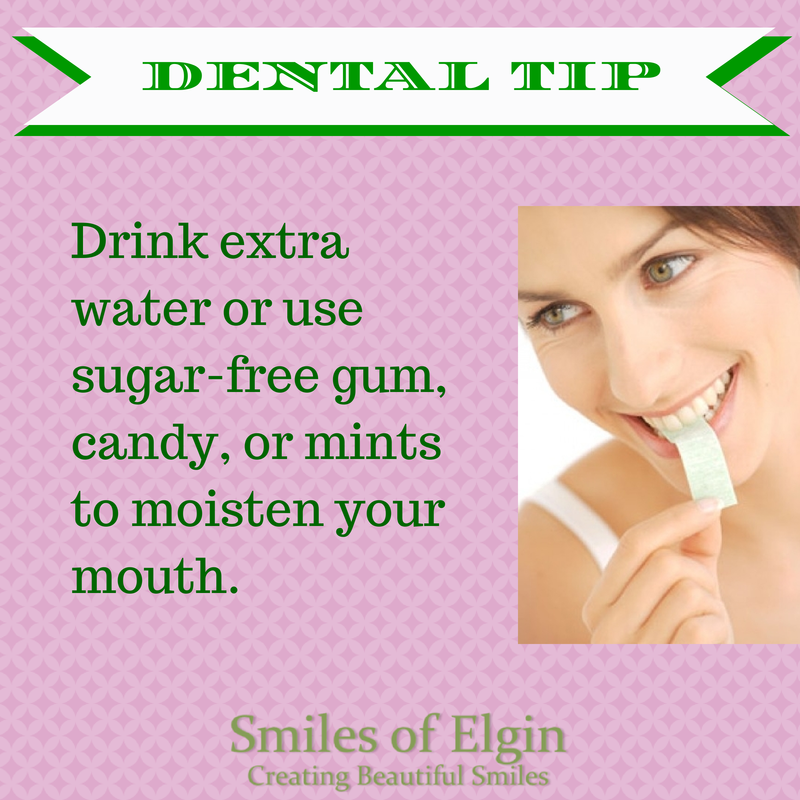
      Manage dry mouth in healthy ways. Drink extra water or use sugar-free gum, candy, or mints to moisten your mouth. Saliva substitutes and oral moisturizers can also be helpful. Talk to your pharmacist or dentist about other ideas.

      dry mouth treatment elgin

      Recent Comments

        Archives

        Office Hours

        Monday 10:00 to 6:00
        Tuesday 10:00 to 6:00
        Wednesday 11:00 to 8:00
        Thursday 10:00 to 6:00
        Friday 10:00 to 6:00
        Saturday 8:00 to 3:00
        Sunday Appointment only

        Meet each other with a smile

        Meet each other with a smile

        With family, it is never impossible to smile.

        family smiles elgin dentists

        Recent Comments

          Archives

          Office Hours

          Monday 10:00 to 6:00
          Tuesday 10:00 to 6:00
          Wednesday 11:00 to 8:00
          Thursday 10:00 to 6:00
          Friday 10:00 to 6:00
          Saturday 8:00 to 3:00
          Sunday Appointment only

          How to Properly Take Care of Dental Implants

          How to Properly Take Care of Dental Implants

          A dental implant can last a lifetime with proper dental hygiene. Your dental implants can’t get cavities but they do require regular care. To keep your adjacent teeth or gums from becoming infected, implants should be brushed and flossed along with your natural teeth. Smoking is also considered a risk for implants. If you are going to get an implant and you smoke, you should try to quit because not only can it stain, smoking can also cause gum problems. If proper oral hygiene is neglected, the gums surrounding your implant can become infected. The infection can cause inflammation of the gums and if not treated early, can lead to bone loss around the implant. This will then cause your implant to become loose. Similar to periodontitis, which afflicts natural teeth, this is called peri-implantitis. It occurs in one of every ten implants and may require surgery or cause failure of the implant.

          Brushing and Flossing

          When your dental implant has just been inserted, you will notice that the area around it will be too sensitive to brush for a while. But you can prevent plaque buildup in the area by using an anti-bacterial mouthwash. You can start regular brushing of your tooth implant once the crown has been attached. Regular toothbrushes can’t access the space between teeth, so besides flossing, you can brush the areas between your teeth and adjacent to your implant with a special tiny brush called an interdental brush. Finally, you can use antibacterial toothpaste. Studies have shown that such toothpastes help implants stay healthy.

          Recent Comments

            Archives

            Office Hours

            Monday 10:00 to 6:00
            Tuesday 10:00 to 6:00
            Wednesday 11:00 to 8:00
            Thursday 10:00 to 6:00
            Friday 10:00 to 6:00
            Saturday 8:00 to 3:00
            Sunday Appointment only

            What You Need to Know About Teeth Cleaning

            What You Need to Know About Teeth Cleaning

            There are different types of procedures that are carried out by the dentist in the office and each one of these procedure are performed to achieve a specific goal. In some cases, the dental treatments are therapeutic and corrective in nature so they are meant to resolve all kinds of dental issues; but some of the treatment procedures can be preventive in nature, so they are performed in an effort to avoid the onset of oral disease. Teeth cleaning is an example of a preventive dental procedure. This dental procedure is also known as oral prophylaxis, dental cleaning or dental scaling, and it involves the cleaning of the teeth surface to remove adherent plaque, whether hard or soft.

            The following are some information you need to know about teeth cleaning:

            Patients are encouraged to visit their dentists twice a year or every six months. During these visits, it is important that they come in for a teeth cleaning. Patients are required to see their dentists twice a year for teeth cleaning; when it is impossible, at least one teeth cleaning a year may be enough. In some cases, a patient may be asked to see the dentist every week, or after three months —- this is applicable for more complicated cases where a patient’s gum condition is compromised. Your own efforts at home should be beneficial but they can only achieve so much. Collection at the subgingival space is not always accessed and cleaned properly through brushing and flossing. The dentist makes use of scalers that are shaped in such a way so that it can scrape through the deeper areas along the curvatures of the teeth. The length of time that a teeth cleaning procedure should cover will depend on the oral health condition of the patient. Ideally routine teeth cleaning procedures should run for about 15 to 30 minutes and that involves scaling through all the teeth in both the upper and lower arches. Sometimes, the dental condition of the patient is more severe, and more thorough scaling is required. For these cases, teeth cleaning may go for as long as an hour or two hours, especially where there is heavy staining. During a teeth cleaning procedure, the dentist will be scaling through the subgingival space and may touch or sever some fibrous tissue. Bleeding may be present and this should be normal, so do not be alarmed. The condition should normalize after a while, usually as soon as the procedure is completed or a few hours after the appointment. When normal teeth cleaning is not enough to clean and restore the teeth and gums to health, more invasive procedures may be required. Deep cleaning involves a more invasive access into the subgingival area, where much of the plaque and tartar has collected. When the bone and the roots of the teeth are affected, a surgical intervention involving some gum incision may be necessary so that the dentist can plane the roots. To remove adherent plaque in the root area, the gums will have to be incised so that the infected area can be accessed.

            Recent Comments

              Archives

              Office Hours

              Monday 10:00 to 6:00
              Tuesday 10:00 to 6:00
              Wednesday 11:00 to 8:00
              Thursday 10:00 to 6:00
              Friday 10:00 to 6:00
              Saturday 8:00 to 3:00
              Sunday Appointment only